


_edited.png)
Why Brand Positioning Matters for Marketers
- Feb 9
- 7 min read

Standing out in a crowded market often means the difference between customer growth and getting lost among competitors. For Canadian and American marketing managers navigating professional services, defining brand positioning is much more than a buzzword. It shapes how clients categorize your business and choose between your offer and the next. Clear guidance on building a unique mental image sets the foundation for greater loyalty and long-term success.
Table of Contents
Key Takeaways
Point | Details |
Importance of Brand Positioning | Establishing a clear brand position is essential for differentiation and consumer perception, influencing customer loyalty and market presence. |
Types of Positioning Strategies | Employ various positioning strategies like differentiation, value-based, emotional, and competitive to create a compelling market identity. |
Impact on Trust and Loyalty | Consistent branding and emotional connections drive customer loyalty, enhancing the overall brand experience and value. |
Risks of Poor Positioning | Lack of clear positioning can lead to market invisibility and diminished brand loyalty, making brands vulnerable to competition. |
Defining Brand Positioning and Key Concepts
Brand positioning represents the strategic process of establishing a distinctive mental image of a product or company within customers’ minds. At its core, positioning aims to create a unique perception) that differentiates a brand from its competitors.
Understanding brand positioning involves recognizing several critical components:
Mental Perception: How customers perceive and categorize your brand
Product Differentiation: What makes your offering unique
Market Segmentation: Identifying and targeting specific customer groups
Competitive Landscape: Understanding your position relative to other brands
The fundamental goal of brand positioning is to carve out a specific, memorable space in consumers’ minds. This isn’t about fabricating an artificial image, but strategically communicating your brand’s authentic value proposition. By systematically guiding brands in strategic market placement, companies can effectively communicate their core strengths and unique attributes.
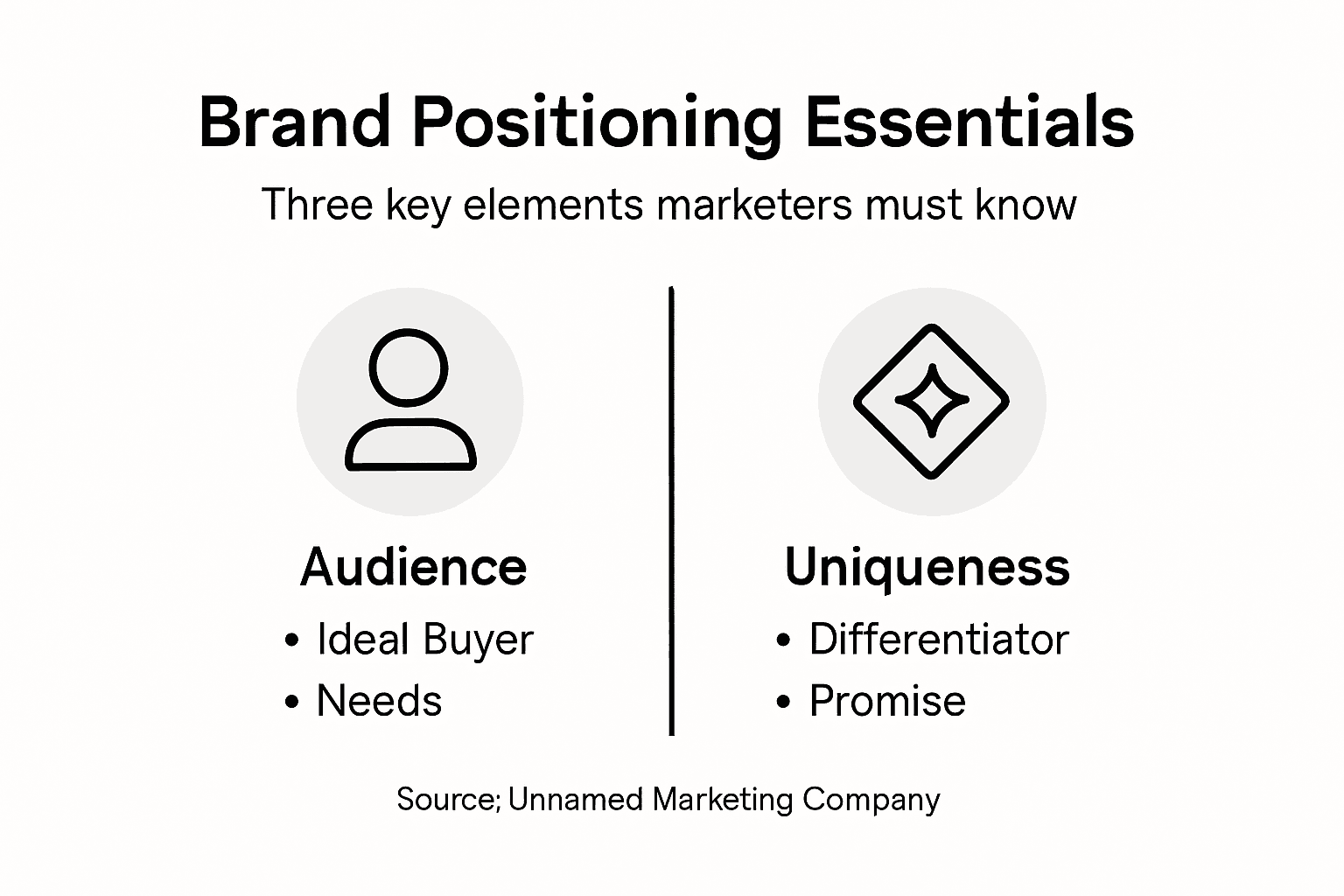
Successful brand positioning requires deep understanding of three key dimensions: your target audience, your brand’s unique capabilities, and the competitive environment. Marketers must craft a narrative that resonates authentically while differentiating from alternative options.
Pro tip: Conduct regular market research to ensure your brand positioning remains relevant and compelling in an evolving competitive landscape.
Types of Brand Positioning Strategies Explained
Marketers have several strategic approaches to brand positioning, each designed to create a unique and compelling market presence. Disruptive market positioning strategies challenge traditional marketing norms by redefining consumer expectations and creating distinctive brand identities.
Key types of brand positioning strategies include:
Differentiation Positioning: Highlighting unique product features
Value-Based Positioning: Emphasizing cost-effectiveness or superior quality
Emotional Positioning: Creating strong psychological connections with consumers
Competitive Positioning: Directly addressing competitor strengths and weaknesses
Niche Positioning: Targeting specific market segments with specialized offerings
Some innovative positioning approaches include:
Stealth Positioning: Quietly entering the market with unexpected innovations
Reverse Positioning: Challenging existing market assumptions
Breakaway Positioning: Creating entirely new market categories
Successful brand positioning requires continuous adaptation to market changes, ensuring that your brand remains relevant and compelling. Marketers must deeply understand their target audience, core brand values, and competitive landscape to develop effective positioning strategies.
Here’s how common positioning strategies differ in approach and effect:
Strategy Type | Core Focus | Typical Outcome |
Differentiation | Unique features or benefits | Strong competitive distinction |
Value-Based | Cost or quality advantage | Perception of higher value |
Emotional | Consumer connection | Lasting brand loyalty |
Niche | Specific market segments | Deep market penetration |
Competitive | Direct rivalry response | Increased market share rivalry |
Pro tip: Regularly conduct market research and consumer feedback analyses to refine and evolve your brand positioning strategy.
How Brand Positioning Shapes Market Perception
Brand positioning critically influences how consumers perceive and interact with products in competitive markets. This strategic approach determines whether a brand is viewed as unique, familiar, or indistinguishable from its competitors.
Key dimensions of market perception include:
Similarity Perception: How closely consumers associate the brand with existing category offerings
Differentiation Signals: Unique attributes that distinguish the brand
Emotional Resonance: Psychological connections beyond functional features
Trust Indicators: Elements that build consumer confidence
Competitive Context: Relative positioning within the market landscape
Effective brand positioning builds substantial brand equity by aligning messaging with buyer interests. This strategic alignment shortens sales cycles and increases customer preference by embedding the brand more deeply in consumer consciousness.

The nuanced interplay between brand positioning and market perception determines critical consumer behaviors. Strong positioning can create brand loyalty, reduce price sensitivity, and transform casual customers into passionate advocates.
Pro tip: Conduct periodic market perception studies to understand how your brand positioning resonates with target audiences and identify opportunities for strategic refinement.
Impact on Trust, Loyalty, and Customer Choice
Branding creates emotional connections that transform transactional relationships into deep, meaningful customer experiences. These connections go far beyond simple product features, establishing a profound psychological bond between consumers and brands.
Key elements that drive trust and loyalty include:
Consistent Messaging: Maintaining a uniform brand voice across all interactions
Emotional Resonance: Creating genuine connections that transcend functional benefits
Reliability Signals: Demonstrating dependability through predictable performance
Transparency: Openly communicating brand values and business practices
Customer Experience: Delivering consistently positive interactions
Brand management strategically builds consumer trust by articulating a clear brand promise and maintaining a consistent experience. This strategic approach transforms casual customers into loyal brand advocates who choose your offering not just for its features, but for its perceived value and emotional significance.
The cumulative impact of effective brand positioning manifests in measurable business outcomes. Strong brand loyalty can reduce customer acquisition costs, increase repeat purchases, and create powerful word-of-mouth marketing that amplifies your brand’s reach and credibility.
Pro tip: Regularly audit your brand touchpoints to ensure consistent messaging and emotional alignment with your target audience’s evolving expectations.
Risks of Poor or Unclear Positioning
Lack of clear brand positioning can create significant challenges for businesses, leading to market confusion and diminished competitive advantage. When brands fail to establish a distinct identity, they become indistinguishable from competitors, making it difficult to attract and retain customers.
Key risks of poor positioning include:
Market Invisibility: Blending into the background of competitive landscapes
Customer Confusion: Sending mixed or unclear brand messages
Reduced Perceived Value: Inability to justify premium pricing
Weakened Brand Loyalty: Failing to create meaningful connections
Increased Vulnerability: Easier targets for competitive displacement
Poor positioning creates significant sales vulnerabilities by leaving brands exposed to direct imitation and price-based competition. Without a clear value proposition, businesses become commodity providers, forced to compete solely on price rather than unique benefits.
The consequences extend beyond immediate sales. Unclear positioning erodes brand equity, making future marketing efforts more challenging and expensive. Companies may find themselves constantly reinventing their message, exhausting resources without creating lasting market impact.
This table summarizes the business impact of strong vs. weak brand positioning:
Positioning Quality | Customer Perception | Business Impact |
Strong | Clear and differentiated | High loyalty, premium pricing |
Weak | Confused or indifferent | Price sensitivity, low retention |
Evolving | Adaptive and relevant | Sustained market advantage |
Pro tip: Conduct a comprehensive positioning audit annually to ensure your brand messaging remains sharp, differentiated, and aligned with evolving market expectations.
Practical Steps for Stronger Brand Positioning
Brand positioning requires strategic clarity that goes beyond surface-level marketing tactics. Successful companies develop a comprehensive approach that integrates their core mission, values, and unique market perspective into every customer interaction.
Key steps for developing a robust brand positioning strategy include:
Define Core Identity: Articulate mission, vision, and fundamental values
Understand Target Audience: Conduct deep market research
Analyze Competitive Landscape: Identify unique differentiation points
Create Consistent Messaging: Develop unified verbal and visual language
Align Internal Culture: Ensure team understands and embodies brand promise
Targeting buyer interests with relevant messaging demands continuous adaptation and monitoring. Successful brands remain agile, regularly reassessing their positioning to maintain relevance in dynamic market environments.
The most effective brand positioning strategies integrate external market insights with internal organizational strengths. This approach transforms positioning from a static marketing exercise into a dynamic, evolving business strategy that connects authentically with target audiences.
Pro tip: Conduct quarterly brand perception audits to track how your positioning resonates with customers and identify emerging opportunities for strategic refinement.
Elevate Your Brand Positioning with Proven Strategies
Struggling to create a clear, memorable position for your brand in a crowded market This article highlights the pain points of unclear messaging and weak differentiation that can cause customer confusion and lost loyalty. At Unnamed Marketing Company, we specialize in transforming these challenges into powerful growth opportunities by aligning your brand’s identity with strategic market positioning. Our expertise spans growth strategy, marketing planning, and brand design to help you craft consistent messaging that resonates emotionally and builds trust.
Explore our tailored Digital Products | Unnamed Marketing Company to access tools that sharpen your positioning presence.

Take action now to stop blending in and start standing out by partnering with our team to refine your brand’s unique value proposition. Visit Unnamed Marketing Company today to learn how we help businesses clarify direction and grow with intention. Your brand deserves a position that drives loyalty and lasting success.
Frequently Asked Questions
What is brand positioning?
Brand positioning is the strategic process of establishing a distinctive mental image of a product or company in customers’ minds, aiming to differentiate the brand from its competitors.
Why is brand positioning important for marketers?
Brand positioning is crucial for marketers as it helps create a unique perception of the brand, enhances customer loyalty, and influences buying decisions. It also allows brands to communicate their core strengths effectively.
What are some common brand positioning strategies?
Common brand positioning strategies include differentiation positioning, value-based positioning, emotional positioning, competitive positioning, and niche positioning, each focusing on unique aspects such as product features or specific target markets.
How can poor brand positioning affect a business?
Poor brand positioning can lead to market invisibility, customer confusion, reduced perceived value, weakened brand loyalty, and increased vulnerability to competitors, ultimately harming sales and brand equity.
Recommended

Comments